For many mining investors and operators, how to efficiently and stably convert iron ore into high-grade iron concentrate is not just a technical issue – it directly affects project return on investment, operating costs, and long-term sustainable profitability. Iron is one of the most widely distributed metal elements on Earth, with an average crustal abundance of about 5%. However, iron ores with industrial mining value are not found everywhere – only deposits enriched under specific geological conditions are economically viable. Upgrading low-grade run-of-mine ore to high-grade iron concentrate is a systematic engineering effort covering ore characterization, process selection, equipment configuration, and cost control. This article provides a complete iron ore beneficiation solution and technical roadmap. Whether you are a new investor entering the mining sector, a plant manager seeking equipment upgrades, or a process engineer needing to optimize flowsheets, you will find systematic and practical reference information here.
1. Know Your Ore
Before starting any iron ore beneficiation project, ore property identification is the decisive first step. The ore type directly determines the applicable beneficiation method, the selection of core equipment, and the final concentrate grade and recovery.
1.1 Main Types of Iron Ore
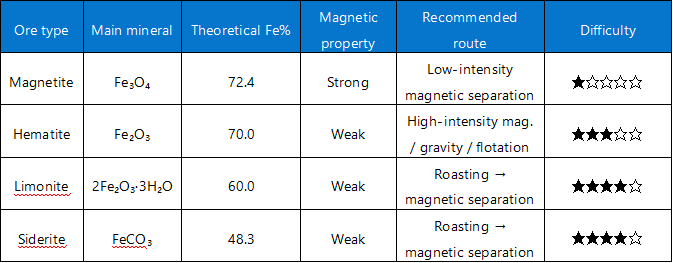
Based on the iron mineral species and magnetic characteristics, commercially important iron ores fall into four major categories: Magnetite: The primary mineral is Fe₃O₄, with a theoretical iron content of 72.4% and strong magnetic susceptibility. This is the most amenable ore type, offering the simplest flowsheet and lowest processing cost.Because of its strong magnetism, low-intensity magnetic separation achieves efficient separation with a short process and low cost. Hematite: The primary mineral is Fe₂O₃, theoretical iron 70.0%, weakly magnetic. Hematite is the most widely distributed iron mineral, often reddish to steel‑grey. Due to its weak magnetism, low‑intensity magnetic separation cannot be used; it typically requires high‑intensity magnetic separation, gravity concentration, flotation, or combined flowsheets, making the process more complex. Limonite: The primary mineral is 2Fe₂O₃·3H₂O, theoretical iron about 60.0%, weakly magnetic. Limonite is a hydrous iron oxide, usually formed by weathering of other iron minerals. Its te has relatively low iron content, and carbonate minerals may generate CO₂ bubbles during processing, affecting separation. Roasting pretreatment is usually required before magnetic separation.
1.2 Ore Grade and Industrial Value
The iron content of an ore – its “grade” – is the core indicator of economic value.
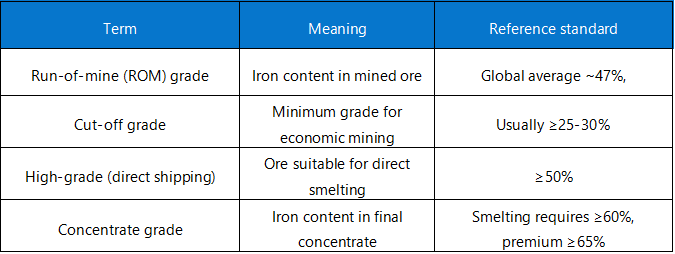
Actual mining value is a comprehensive assessment. Besides grade, you must also consider orebody scale, mining method, beneficiation recovery, infrastructure, and local environmental regulations.
2. Common Beneficiation Methods for Iron Ore
After fully understanding the ore properties, the second core question emerges: which beneficiation process should be adopted for this ore? Correct process selection is key to achieving high recovery and low operating costs.
For the vast majority of iron ores, the commonly used methods can be grouped into four categories: magnetic separation, gravity concentration, flotation, and combined flowsheets.
2.1 Magnetic Separation – The Core Method
Principle and applicability: Magnetic separation exploits differences in magnetic susceptibility between minerals to separate magnetic from non‑magnetic particles in a non‑uniform magnetic field. It is the most widely used and most efficient method for iron ore, particularly for magnetite.
For strongly magnetic magnetite, low‑intensity magnetic separation (field strength 0.1‑0.3 T) is sufficient. For weakly magnetic minerals like hematite and limonite, high‑intensity magnetic separation (field strength ≥1.0 T) is required.
Typical equipment: Wet permanent drum magnetic separators, high‑gradient magnetic separators, etc.
Advantages: Simple flowsheet, low operating cost, no reagents, environmentally friendly – the preferred choice for iron ore beneficiation.
2.2 Gravity Concentration – Effective Use of Density Difference
Principle and applicability: Gravity concentration utilises the significant density difference between iron minerals (4.5‑5.2 g/cm³) and gangue (e.g., quartz ~2.65 g/cm³) to separate heavy and light particles using water or air. It is suitable for coarse‑grained iron ores and placer iron deposits.
Typical equipment: Jigs, shaking tables, spiral concentrators, etc.
Advantages and challenges: Simple process, low cost, no reagents; but recovery for fine particles (<0.074 mm) is low. Often used as a pre‑concentration or auxiliary step.
2.3 Flotation – Solution for Fine and Complex Ores
Principle and applicability: Flotation is a physicochemical separation method that uses differences in surface wettability. By adding reagents, valuable minerals attach to air bubbles and float to the surface. It is suitable for fine‑grained hematite, polymetallic iron ores, and cases requiring removal of impurities like phosphorus and sulfur.
Typical equipment: Flotation machines (XJK, SF types, etc.).
Advantages and challenges: Good recovery for fine particles, strong adaptability; but requires chemical reagents, higher operating cost, and more demanding operation management.
2.4 Combined Flowsheets – Comprehensive Solution for Complex Ores
For ores with complex mineralogy where a single method cannot achieve satisfactory results, a combined flowsheet incorporating multiple techniques is necessary.
Common combinations:
“Stage grinding – low‑intensity magnetic separation – reverse flotation” (for upgrading magnetite concentrate)
“High‑intensity magnetic separation – gravity – flotation” (for hematite)
“Roasting – low‑intensity magnetic separation” (for limonite and siderite)
Design principle: “Tailor to the ore, stage separation” – use lower‑cost physical methods for pre‑concentration first, then apply more advanced separation according to ore characteristics. Comparison of beneficiation methods:
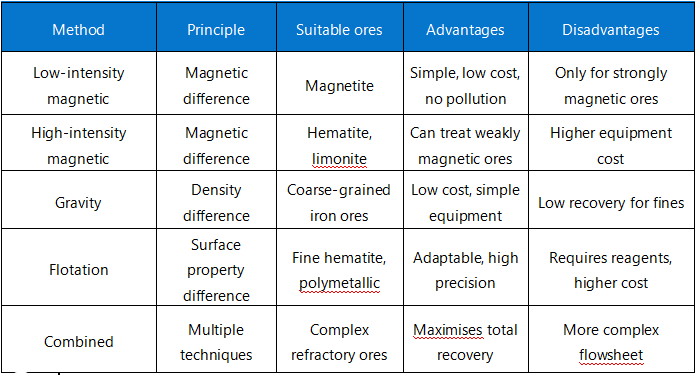 Please note: not all iron ores use the same flowsheet. The correct approach is: first conduct rigorous beneficiation tests, then select the process scientifically based on test data and economic evaluation – never buy equipment without data support.
3. From Iron Ore to Concentrate: A Typical Plant Flowsheet Explained
For many mine owners and investors, the most direct question is: “From run‑of‑mine to final iron concentrate, what are the key steps? ”
Below we illustrate the entire industrial path through a typical magnetite processing plant, naturally introducing the core equipment needed at each stage.
3.1 Crushing and Screening – Making Ore “Smaller”
Objective: Reduce run‑of‑mine boulders to a size suitable for grinding (typically ≤20‑25 mm) to achieve “more crushing, less grinding” and reduce downstream grinding energy consumption.
Process configuration: Crushing is usually done in three stages – primary, secondary, and tertiary – reducing feed size from metre scale to mill feed size.
Primary crushing: A Jaw Crusher reduces ≤1200 mm feed to ≤300 mm. The jaw crusher is robust, stable, and the first choice for most plants.
Secondary crushing: A Standard Cone Crusher reduces ≤300 mm to ≤80 mm. Cone crushers are well‑suited for hard rocks and produce consistent product shape.
Tertiary crushing: A Short‑head Cone Crusher in closed circuit with a Circular Vibrating Screen reduces ≤80 mm to ≤20 mm, with oversize returned for re‑crushing.
Key principle: “More crushing, less grinding” – crushing consumes far less energy per tonne than grinding, so aim to crush as fine as possible before milling.
3.2 Grinding and Classification – The Core Step Determining Performance
Objective: Grind the crushed ore to a fine pulp so that iron minerals are fully liberated from gangue – the basis for high separation recovery.
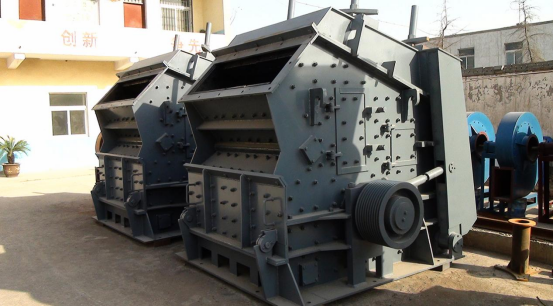 Process configuration:
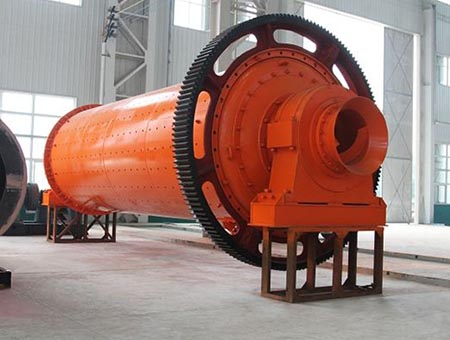
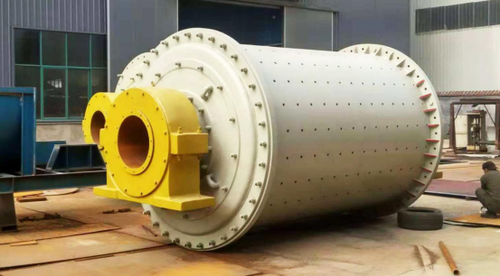
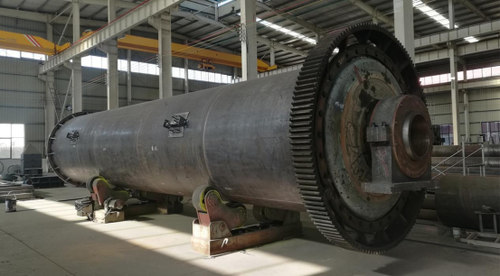
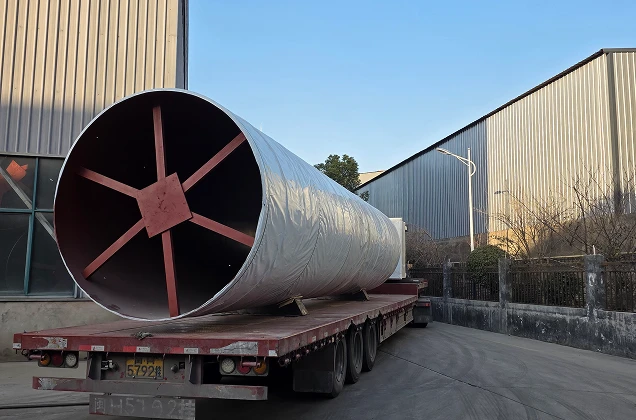
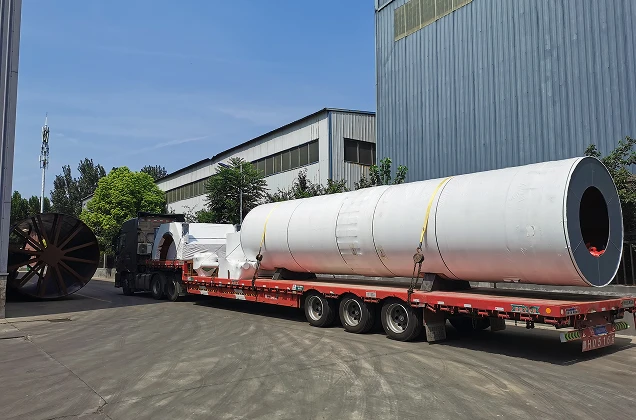
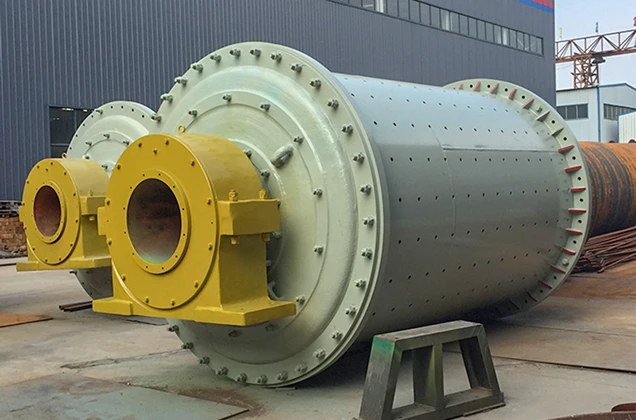
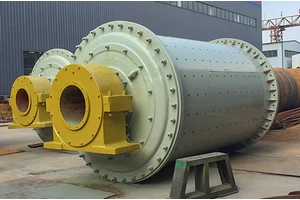
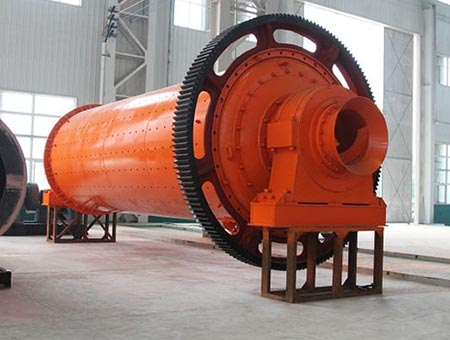
Primary grinding: Crushed product (≤20‑25 mm) enters a Ball Mill for coarse grinding. The ball mill is the most common grinding device in iron ore plants, available in grate and overflow discharge types.
Classification control: The mill discharge goes to a Spiral Classifier or Hydrocyclone for size separation. The fine underflow (or overflow) proceeds to the next stage; coarse sands return to the ball mill for regrinding, forming a closed circuit.
Secondary grinding (if needed): For ores with fine liberation size, one stage may not suffice; a second grinding and classification stage is added.
Key principle: The target grind size must be determined by beneficiation test data, based on the degree of liberation – not blindly “finer is better”, which wastes energy and steel.
Core equipment in this stage – Ball Mill specifications:
Hongke Heavy Industry produces ball mills covering Φ900×1800 to Φ5500×8500 with capacity 0.65‑615 t/h and ball charge 1.5‑338 t. Feed size ≤20‑25 mm, product size adjustable to 0.075‑0.4 mm. Discharge types: MQG dry grate type, MQS wet grate type, MQY wet overflow type, MQZ peripheral discharge type. Liner options: Series A (high‑manganese, magnetic liners) standard, Series B (rubber, high‑alumina, silica, ceramic liners) energy‑saving – Series B saves 10‑20% energy compared to Series A. Drive types: edge drive and center drive.
3.3 Separation and Concentration – Separating Iron from Gangue
Objective: Separate and concentrate the iron minerals according to ore properties to achieve “more iron in less mass, less iron in more mass” – i.e., maximise iron recovery in the concentrate while minimising iron loss in tailings.
Typical magnetite process:
Low‑intensity roughing: The mill overflow enters a Wet Permanent Drum Magnetic Separator (field 0.15‑0.25 T). Magnetic product proceeds to cleaning; non‑magnetic is discarded as tailings.
Low‑intensity cleaning: The rough concentrate goes through one or more cleaning stages (field strength gradually decreased) to produce final concentrate of ≥63% Fe. Middlings are returned for regrinding.
Alternative for hematite/limonite:
Gravity pre‑concentration: If the ore contains coarse hematite, gravity equipment (jigs, shaking tables, spirals) can be arranged after grinding.
High‑intensity magnetic / flotation: For fine hematite, high‑gradient magnetic separators or flotation machines are used.
| Method | Principle | Suitable ores | Advantages | Disadvantages |
|---|---|---|---|---|
| Low intensity magnetic | Magnetic difference | Magnetite | Simple, low cost, no pollution | Only for strongly magnetic ores |
| High intensity magnetic | Magnetic difference | Hematite, limonite | Can treat weakly magnetic ores | Higher equipment cost |
| Gravity | Density difference | Coarse grained iron ores | Low cost, simple equipment | Low recovery for fines |
| Flotation | Surface property difference | Fine hematite, polymetallic | Adaptable, high precision | Requires reagents, higher cost |
| Combined | Multiple techniques | Complex refractory ores | Maximises total recovery | More complex flowsheet |
3.4 Thickening and Dewatering – Final Step for the Concentrate Product
Objective: Remove water from the concentrate pulp to obtain a dry, transportable product suitable for smelting.
Process configuration:
Thickening: Concentrate pulp enters a Thickener for gravity settling to increase pulp density.
Filtration: Underflow goes to a Disc Vacuum Filter or Ceramic Filter to reduce moisture to ≤10%.
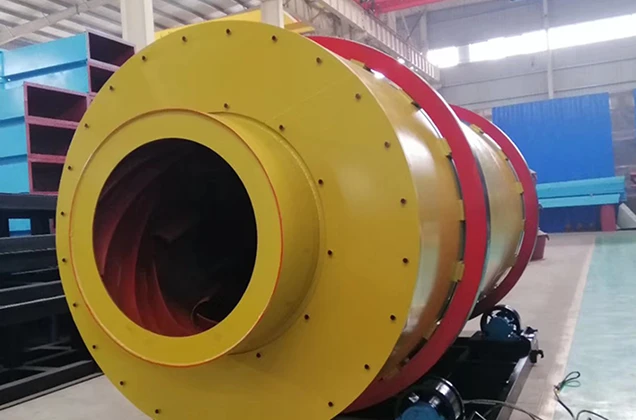
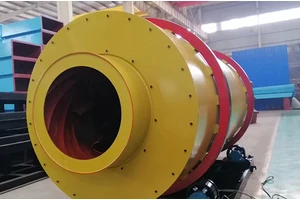
Drying (optional): In cold regions or for special requirements, a Rotary Dryer can further reduce moisture to ≤5%.
3.5 Tailings Disposal and Environmental Protection
Objective: Tailings treatment is the final stage of the plant flowsheet and a critical environmental aspect.
Requirements: Tailings must be properly treated before discharge to meet local environmental standards. If tailings still contain valuable elements, consider secondary recovery to maximise resource utilisation.
A typical magnetite beneficiation chain can be summarised as: ROM → primary crushing → secondary crushing → tertiary crushing + screening → grinding + classification → low‑intensity roughing → low‑intensity cleaning → concentrate thickening → concentrate filtration → iron concentrate (tailings to tailings pond).
4. Common Iron Ore Beneficiation Equipment List
After determining the scientific process flowsheet, the next step is to translate that flowsheet into specific equipment configuration. For customers, the most direct question is: “Exactly what equipment do I need to buy to build this production line? ”
This section systematically lists the main equipment required for each of the five core processing stages.
4.1 Crushing Section
Objective: Reduce large run‑of‑mine rocks to grinding feed size (typically ≤20‑25 mm).
| Equipment | Function and applicability | Stage |
|---|---|---|
| Jaw Crusher | Primary crushing; robust and stable – the first choice for most plants | Stage 1 |
| Standard Cone Crusher | Secondary crushing; suitable for hard iron ores, consistent product shape | Stage 2 |
| Short‑head Cone Crusher | Tertiary crushing; longer parallel zone, better for fine reduction | Stage 3 |
| Circular Vibrating Screen | Forms closed circuit with tertiary crusher to ensure product size | Screening |
4.2 Grinding and Classification Section
Objective: Grind crushed ore to the fineness required for separation, achieving full liberation of iron minerals.
| Equipment | Function |
|---|---|
| Ball Mill | Main grinding equipment; available in wet, grate, overflow types depending on ore and product requirements |
| Spiral Classifier | Forms closed circuit with mill for coarse classification; ensures correct product fineness |
| Hydrocyclone | Forms closed circuit with mill; higher classification efficiency than spiral, suitable for fine grinding |
| Slurry Pump | Conveys pulp |
4.3 Separation Section
Objective: Separate iron minerals from pulp using physical or physicochemical methods.
| Equipment | Application scenario |
|---|---|
| Wet Permanent Drum Magnetic Separator | For magnetite; available in three tank styles (concurrent, counter‑current, semi‑counter‑current) for different particle sizes |
| High‑Gradient Magnetic Separator | High‑intensity separator for weakly magnetic minerals like hematite and limonite |
| Flotation Machine (XJK/SF) | For fine hematite or removal of impurities (P, S, etc.) |
| Jig / Shaking Table / Spiral Concentrator | Gravity equipment for pre‑concentration or cleaning of coarse hematite |
4.4 Dewatering Section
Objective: Solid‑liquid separation to reduce moisture content of the concentrate.
| Equipment | Function |
|---|---|
| Thickener | Gravity sedimentation to increase pulp density |
| Disc Vacuum Filter / Ceramic Filter | Deep dewatering to ≤10% moisture |
| Rotary Dryer (optional) | Further reduces moisture to ≤5% |
4.5 Auxiliary Equipment
Objective: Support stable operation of the entire system.
| Equipment | Function |
|---|---|
| Vibrating Feeder | Evenly feeds ore from bin to crusher |
| Belt Conveyor | Transports material between stages |
| Storage Bins | Buffer and store materials |
| Pumps | Pulp conveying |
Expert customisation and turnkey solutions: Hongke Heavy Industry focuses on providing customised complete beneficiation production line solutions, integrating all the above sections seamlessly. From efficient crushing front‑end to grinding, separation, and dewatering back‑end, you get a one‑stop, ore‑tailored complete line.
5. How to Choose the Right Beneficiation Equipment for Your Needs
What really determines project success is not the price of a single machine, but whether the entire process and equipment combination can deliver stable, long‑term profitability for your mine.
5.1 First Analyse Your Ore, Then Select Equipment
Understanding ore characteristics is the first step in selection:
Ore type – magnetite, hematite, limonite or siderite? Each requires a different process route.
Iron grade and liberation size – grade determines economic value; liberation size determines grind target and number of grinding stages.
Harmful elements – sulfur, phosphorus, potassium, etc., affect concentrate quality and downstream smelting.
Key advice: A rational flowsheet must be based on systematic beneficiation tests and mineralogical analysis, not on experience alone.
5.2 Match Processing Capacity with Investment Capability
Different annual throughput volumes require different equipment configurations. Sizing should be based on target capacity, with equipment specifications and quantities derived accordingly.
| Project scale | Annual throughput | Typical configuration |
|---|---|---|
| Small | ≤300,000 t | Jaw crusher + cone crusher + ball mill + classifier + magnetic separator + dewatering |
| Medium | 300,000 – 1,000,000 t | Multiple crushers + ball mills + cyclone cluster + magnetic separators + thickening & filtration |
| Large | >1,000,000 t | Gyratory crusher + multiple cone crushers + large ball mills + automation + tailings system |
5.3 Practical Selection Points for Ball Mills
The ball mill is the single largest capital cost and energy consumer in the entire line. Key selection considerations:
Step 1: Calculate required throughput (t/h)
Required throughput (t/h) = Annual capacity ÷ (working days per year × operating hours per day)
Step 2: Match size according to capacity
Hongke ball mills cover Φ900×1800 to Φ5500×8500, capacity 0.65‑615 t/h, motor power 18.5‑4500 kW. Reference sizing:
| Annual throughput | Required (t/h) | Recommended ball mill size | Motor power (kW) |
|---|---|---|---|
| 100,000 t/y | ~20 | Ф1830×3000 ~ Ф2100×3000 | 130‑155 |
| 300,000 t/y | ~60 | Ф2700×4500 ~ Ф3200×4500 | 480‑800 |
| 600,000 t/y | ~120 | Ф3600×6000 or above | ≥1250 |
| ≥1,000,000 t/y | ≥200 | Ф4200×6500 or above | ≥1500 |
Final selection must be based on ore grindability test data.
Step 3: Determine number of grinding stages based on liberation size
Coarse liberation (>0.2 mm): single stage grinding
Fine liberation (<0.1 mm): two stages required
Step 4: Ball size distribution guidelines
Coarse liberation → larger balls (Φ80‑100 mm) for impact breakage
Fine liberation → smaller balls (Φ40‑60 mm) for attrition
5.4 Comprehensive Evaluation of Operating Costs
When selecting equipment, do not only look at purchase price – also assess long‑term operating costs:
Energy consumption – crushing and grinding are the most energy‑intensive; equipment efficiency directly affects cost per tonne. Series B energy‑saving ball mills can reduce energy by 10‑20% compared to Series A.
Wear parts – jaw plates, liners, grinding balls, screen meshes – their service life and replacement costs can make a huge difference over years of operation.
Automation level – PLC/DCS control systems help stabilise operation and improve recovery.
5.5 Choose “Solution Capability”, Not Just Equipment
For customers needing a complete production line, we recommend focusing on your partner’s:
✓ Technical capability – can they provide beneficiation test services and process design, not just a quotation?
✓ Track record – do they have successful cases with similar iron ores, with long‑term performance data and customer feedback?
✓ Quality system – from steel plate cutting, welding, machining to final inspection – do they have a comprehensive quality management and traceability system?
✓ Service capability – can they dispatch engineers for on‑site installation, training and process optimisation? What is their response time?
Beneficiation equipment selection is a highly customised, data‑driven scientific decision – please never rely on experience or blind purchasing. To reduce your upfront trial‑and‑error cost, Hongke Heavy Industry offers beneficiation testing and process validation services: simply send us a representative sample, and we will complete lab‑scale beneficiation tests, process parameter analysis, feasibility assessment, and provide the optimal process recommendation and equipment configuration.
6. Customised Solution Services
Every mine is unique – ore properties vary widely, and no single equipment package fits all scenarios. Therefore, we offer professional one‑on‑one customised solution services:
If you already have a mineral test report: Please provide your report (including ore type, grade analysis, liberation size, mineral composition, etc.). Our professional engineering team will tailor a complete process scheme and equipment list from crushing to final product based on your actual data.
If you have not yet performed mineral testing: We recommend that you first collect a representative sample (20‑50 kg) and send it to a professional institution for beneficiation testing. You can also contact us; we will provide consulting services and recommend partner laboratories to help you take the first step towards scientific selection.
Our services include:
Tailored complete process flow design based on ore characteristics
Full production line equipment selection and matching
Equipment layout and site planning advice
Investment estimation and economic analysis
Installation, commissioning guidance and operator training
Contact us: No matter which stage your project is at – whether you are just beginning exploration, have completed beneficiation tests, or are ready to purchase equipment with confirmed capacity – we welcome your enquiry. Bring your ore information or test report, and our engineers will provide the most professional proposal to ensure every dollar of your investment is well spent.
The right way to contact a manufacturer: Please have your beneficiation test report ready and tell us your ore type, ROM grade, target capacity, and target concentrate grade – we will precisely match the most suitable equipment solution for you.